
AI agents are reshaping e-commerce by automating the shopping journey. Learn what retailers need to survive in the agentic era.
Quick Answer:
AI agents are changing e-commerce by moving product discovery, comparison, and purchasing decisions away from human-led browsing and toward machine-mediated evaluation. Instead of navigating websites, customers increasingly delegate intent to AI assistants that assess structured product data, availability, pricing, and relevance on their behalf.
For retailers, product discoverability is no longer determined by interface design or traditional SEO alone. It depends on whether product catalogs, pricing, and systems are structured for AI interpretation. Retailers that adapt their data, infrastructure, and integrations for agent-driven commerce gain earlier access to AI-mediated demand. Those that do not risk becoming invisible within agent-based shopping workflows.
Traffic from generative AI shopping assistants to retail sites has grown 1,300% year over year. Product evaluation is increasingly happening inside AI systems before a customer reaches a store.
Chatbots and recommendation engines were early signals. What is changing now is the decision layer. AI agents increasingly mediate what gets evaluated, compared, and selected, not just how products are discovered.
Retailers that align systems early tend to see stronger performance over time. The practical question is readiness.
How are AI agents changing commerce, and what does this mean for retailers?
How AI Agents Are Changing the Way We Shop
Shopping behavior is shifting at the interaction level. Customers no longer type simple keywords like "best kids snacks." Instead, they ask detailed questions: "What are some nutritious snack options for a 7-year-old's birthday party?" This changes how people interact with online stores.
The traditional e-commerce funnel of search, browse, compare, add to cart, and checkout is increasingly compressed into conversational interactions.
Shopping used to require multiple steps. Customers navigated categories, applied filters, compared specifications, and repeated this across multiple sites before purchase decisions.
Conversational interfaces replace this workflow. Users describe what they need, and AI agents handle the research and comparison automatically.

Don't let competitors get ahead. Let's talk about adapting your business to agentic commerce.
AI shopping agents go beyond keyword matching. They understand context, preferences, and shopping behavior patterns using multimodal AI models that process visual data, purchase history, and stated needs.
These systems analyze multiple factors simultaneously: body measurements, style preferences, existing wardrobe items, household budgets, and real-time promotions. For grocery shopping, agents suggest recipes based on pantry inventory and dietary preferences while checking for relevant discounts.
As users interact with these systems over time, agents handle increasingly complex tasks. They verify delivery timelines, apply stored payment credentials, and complete purchases with minimal user input. The multi-step shopping process condenses into brief conversations.
Major retailers and tech platforms are deploying AI agents that are reshaping how commerce functions.
Perplexity launched its "Buy with Pro" shopping tool in late 2024, integrating with PayPal for secure checkout directly within the chat interface. The transaction is completed directly within the conversational interface.
OpenAI introduced Operator in January 2025, now integrated into ChatGPT, helping users book travel and restaurant reservations. They recently announced an Agentic Commerce Protocol with Stripe, allowing users to complete purchases without leaving the chat.
Google is expanding its AI Mode shopping interface with advanced agentic capabilities for price tracking and purchase confirmation. "We're moving from a one-to-many pricing strategy to a dynamic, one-to-one model where the negotiation happens between two machines before a human even sees the final offer," notes Toby Brown, Global Managing Director at Google Cloud.
Meta's customer support AI agents show results in a different area. These agents understand context, provide personalized solutions, and escalate complex issues when necessary. Resolution time dropped by 30%, with corresponding improvements in customer satisfaction and retention.
Beyond customer-facing commerce, agent-based approaches are also influencing internal content operations.
In its work with Tech.co, Darwin helped implement AI-supported content workflows that streamlined research, drafting, and publishing processes. These workflows increased content production capacity by eight times while reducing monthly operational costs. The system illustrates how AI can coordinate complex workflows at scale while keeping human decision-making in place.
The investment patterns confirm the momentum. More than half (56%) of retailers increased their generative AI investments over the past year, with 18% already implementing AI agents in production operations.
What AI Commerce Actually Means in Practice
Customer personalization in AI-driven commerce extends beyond surface-level tactics such as name-based messaging. Modern platforms analyze behavioral and contextual data to support individualized decision-making across the shopping journey.
Modern AI systems analyze granular data points like browsing behaviors, location, preferences, and contextual factors such as time of day or weather to support individualized interactions. These systems interpret contextual signals to predict needs before customers explicitly state them.
AI-powered discovery tools transform how customers find products by handling complex, contextual queries instead of keyword matching.
Google Cloud outlines how this works in practice. A customer needing a jacket for Honolulu can specify requirements conversationally: warm when windy but breathable in the sun, with pockets, packable, under $100. An AI agent returns curated options with virtual try-on visualizations, compression demonstrations, and delivery confirmation, while simultaneously negotiating with brand agents for personalized promotions.
This shifts product discovery away from browse-and-filter workflows toward conversational, agent-led evaluation.
Your products won't appear in AI recommendations without structured data. Darwin builds agent-ready systems for retailers.
OpenAI's "Instant Checkout" allows purchases to be completed directly within a ChatGPT conversation. The system uses secure payment tokens for data transfer without exposing card numbers.
User control is maintained through explicit confirmation at each step, with minimal data shared only with permission.
AI-powered platforms extend agent involvement beyond checkout into post-purchase workflows. Real-time data is used to support operational adjustments, feedback collection, and targeted follow-up based on customer context.
Retailers must optimize for two audiences: human shoppers and AI agents. Most current systems serve only humans.
AI agents evaluate products using structured data specifications. They don't browse pages or interpret marketing language. Visual design has no impact on their assessments.
Traditional product descriptions target human readers with promotional copy. An example: "Waterproof running headphones with secure fit."
AI agents require structured specifications formatted as machine-readable data:
Machine-readable specifications have become essential for competitive commerce. The same approach applies to AI-driven supply chain and operational systems. Proper data structure enables AI systems to identify regional demand spikes and redistribute inventory for optimal delivery.
Cleo implemented custom data integration to structure user information for AI-driven personalization while maintaining GDPR compliance. The system ensured data remained accessible to AI agents without compromising security requirements.
Retailers implementing machine-readable catalogs position themselves for AI-driven discovery. Those maintaining unstructured formats become inaccessible to agents evaluating products.
Real implementations demonstrate clear returns. Tech.co deployed AI content workflows that reduced monthly costs by $15,000 while increasing production capacity 8x. Similar data integration and AI readiness projects help organizations lower operational friction and scale output efficiently.
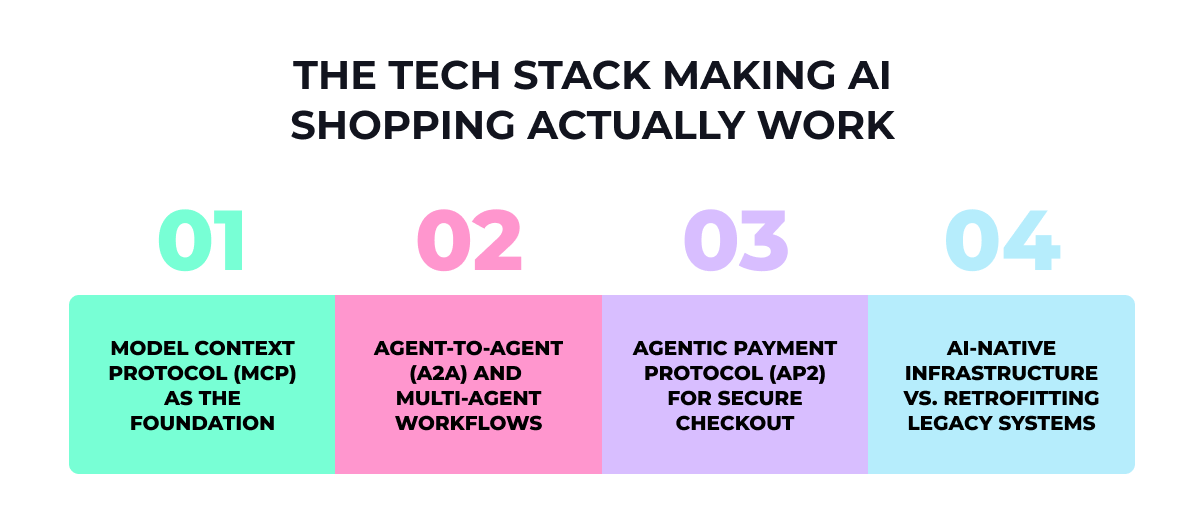
The Tech Stack Making AI Shopping Actually Work
AI-driven commerce relies on a set of emerging protocols that allow agents to access data, coordinate actions, and complete transactions securely. They provide a common interface between AI systems and enterprise infrastructure, including data sources, operational tools, and payments
MCP provides a standardized way for AI systems to access external data sources and perform actions across tools and environments. As an open-source protocol, it reduces reliance on custom integrations and shifts connectivity from point solutions to shared infrastructure.
By establishing a common interface between AI agents and enterprise systems, MCP supports more consistent behavior across data repositories, business tools, and operational platforms.
In commerce environments, the impact of AI increases when multiple agents operate as coordinated systems rather than isolated tools. In multi-agent workflows, specialized agents handle distinct tasks such as product discovery, pricing, and customer support, while coordination mechanisms align their actions across functions.
This coordination replaces siloed decision-making with shared system logic, allowing pricing, inventory, and customer flows to be evaluated and adjusted together.
As AI agents begin to initiate transactions, payment systems must address questions of authorization, verification, and accountability. AP2 introduces a protocol for agent-led payments that enables secure execution while maintaining clear auditability.
Developed with industry partners including PayPal and Mastercard, AP2 uses cryptographically signed mandates to verify user intent and create a verifiable transaction trail without exposing sensitive payment data.
AI-native infrastructure vs. retrofitting legacy systems
Many retailers are attempting to adapt existing platforms to support agent-based workflows. In practice, legacy systems often struggle with fragmented identity models and limited real-time context.
AI-native platforms are designed to support agent interactions from the start, enabling continuous learning, real-time personalization, and coordinated decision-making across channels.
Organizations that invest in AI-native infrastructure are shaping how agent-to-agent commerce operates. Late adopters will need to align with standards defined by others.
Companies that move early are beginning to influence the rules others will need to operate within. As AI-powered retail systems gain scale, early adoption is translating into measurable structural advantages.
The data shows the scale of change. ChatGPT now processes around 50 million shopping-related queries per day, and traffic from AI-driven sources to e-commerce sites has grown by 4,700% year over year.
The disparity is already visible. Walmart receives approximately 20% of its referral traffic from ChatGPT, while Amazon accounts for closer to 3%. This gap reflects differences in how effectively retailers have prepared their catalogs for agent-based discovery.
Early adopters also accumulate proprietary data and workflows that influence how AI systems rank, evaluate, and recommend products over time.
From what I see in practice, products outside an agent’s top recommendations effectively disappear from consideration. Visibility is no longer driven by SEO alone, but by how clearly product data can be evaluated by machines.
This has led to a new discipline: GEO (Generative Engine Optimization). Unlike traditional marketing, GEO focuses on making products legible to AI decision systems rather than optimizing solely for human attention.
Competition is beginning to split into distinct approaches. Google, Shopify, Walmart, Visa, and Mastercard are advancing open protocols such as the Agent Payments Protocol (AP2). Amazon, by contrast, is reinforcing its closed Rufus ecosystem.
This divergence reflects a structural trade-off. Closed systems tend to prioritize control and depth within a single environment, while open standards support interoperability and long-term adaptability.
What this means for you: if you are selecting technology partners at this stage, the ecosystem you align with will shape how flexible your stack remains as agentic commerce evolves. Open protocols typically allow broader integration and discovery, while closed ecosystems concentrate capabilities within one platform.
You now need to establish trust with two audiences: human customers and the AI agents acting on their behalf during purchasing decisions.
Creating machine-readable catalogs alone is not sufficient. Brands must also demonstrate reliability through transparent data and AI practices. Research indicates that 58.5% of consumers are highly concerned about how AI uses their data. At the same time, 92% of shoppers who have used AI-assisted shopping report a positive experience.
This creates a structural tension. Customers expect the efficiency of AI-powered commerce, while remaining cautious about data usage and control. Brands that manage this balance focus on transparency and consistency across both human-facing and machine-facing interactions.
How Darwin Works With Retailers in Agent-Driven Commerce
Retail visibility often no longer starts at product pages or comparison flows. In many cases, purchase decisions are mediated before customers ever reach them.
I often write about this on LinkedIn. Decision-making has moved upstream, inside retail infrastructure, before customers ever interact with brands. Customers let AI agents handle evaluation. As a result, visibility is shaped upstream, before a brand enters the interaction.
Retailers relying on catalog search, SEO ranking, and interface design lose visibility in agent-mediated workflows. Here, infrastructure determines visibility, not presentation.
Darwin works with retailers adapting to agent-driven commerce across Data & Analytics Setup, Integrations & Automations, and AI Readiness & Enablement. We focus on how systems expose data for agent-based evaluation.
The work involves:
Teams typically start by assessing their current catalog structure and system capabilities. From there, Darwin helps define what needs to change and builds the technical foundation required to operate effectively in agent-driven commerce.
Need help structuring data for agentic commerce? We guide retailers through the technical transformation.
Q1. How are AI agents changing the online shopping experience? AI agents are transforming online shopping by enabling conversational interactions, providing personalized recommendations, and streamlining the entire process from product discovery to checkout. They act as personal shoppers, understanding user preferences and needs to offer tailored suggestions and automate many aspects of the shopping journey.
Q2. What is hyper-personalization in AI commerce? Hyper-personalization in AI commerce refers to the use of advanced technologies like artificial intelligence and machine learning to analyze customer data and behavior, creating highly individualized shopping experiences. This includes personalized product recommendations, targeted marketing, and customized user interfaces based on each shopper's unique preferences and habits.
Q3. How can retailers optimize their product catalogs for AI agents? Retailers can optimize their product catalogs for AI agents by making them machine-readable. This involves structuring product data in standardized formats, using precise technical specifications instead of marketing language, and ensuring that product information is clear, factual, and easily interpretable by AI systems.
Q4. What is the Agentic Payment Protocol (AP2)? The Agentic Payment Protocol (AP2) is a secure system developed for AI-led transactions. It addresses issues of authorization, authenticity, and accountability in agent-based purchases by using cryptographically-signed "mandates" that provide verifiable proof of user instructions, creating a non-repudiable audit trail for every transaction.
Q5. Why is it important for retailers to adapt quickly to AI commerce? Adapting quickly to AI commerce is crucial for retailers because early adopters gain significant advantages. They can shape industry standards, capture valuable customer data, establish trust with both users and AI agents, and create sustained competitive edges. As AI commerce is projected to orchestrate trillions in global revenue by 2030, companies that delay risk falling behind in this rapidly evolving landscape.
Contact Darwin today for a custom SEO strategy that combines the best automation tools with proven tactics to dominate Google and AI search results.
Talk to us