Most AI customer experience initiatives fail due to fragmented data, misaligned KPIs, and poor system design. Learn how to build AI CX that actually works.
Quick Answer:
AI improves customer experience only when it is built into customer experience architecture, not added as isolated tools. Most artificial intelligence initiatives in customer experience (AI CX) initiatives fail because customer data is fragmented, KPIs reward deflection instead of resolution, and automation operates without reliable human handoffs. Effective AI CX starts with a unified customer view, applies AI at specific journey decision points, and uses measurable workflows where AI supports agents and customers with full context rather than generic responses.
Recent studies show that 65 percent of CX leaders consider artificial intelligence in customer experience (AI CX) a strategic necessity, one that exposes the limits of existing operating models. Yet most companies still struggle to implement it in a way that improves customer experience in practice.
AI CX has attracted significant attention. Benchmarks often highlight gains in satisfaction, revenue, and cost efficiency, reinforcing the perception that AI adoption is inevitable. However, these outcomes are far from guaranteed.
What causes so many AI CX initiatives to fail?
Many organizations approach AI CX primarily as an automation initiative. They focus on optimizing internal efficiency without rethinking how customers research, decide, and resolve issues across channels. In this context, AI accelerates existing processes but rarely improves customer outcomes.
When AI is implemented as part of a coherent CX strategy, it can preserve customer context, improve routing decisions, and support earlier problem resolution. This goes beyond deploying chatbots or automating email replies. It requires designing customer experience as an interconnected system, where data, workflows, and handoffs operate together.
This article explains why AI customer experience initiatives often fail in real-world conditions and what it takes to design AI as part of a coherent customer experience system.

AI customer experience depends on how data and workflows are structured.
Darwin evaluates your data flows, workflows, and identifies structural gaps.
AI continues to demonstrate strong technical capabilities, yet many implementations fail under real customer conditions. According to Forrester’s 2025 Global Customer Experience Index, CX quality declined for 21% of brands worldwide, with North American scores reaching an all-time low. This gap highlights recurring structural issues in how AI is designed and deployed within customer experience systems.
"I've seen companies lose billions of dollars by treating AI as a quick fix rather than a thoughtful investment. The truth is, if AI is implemented haphazardly or without the right expertise, it can create more complexity than clarity." — Max Schwendner, Co-CEO at Alorica, expert on strategic AI implementation in customer service.
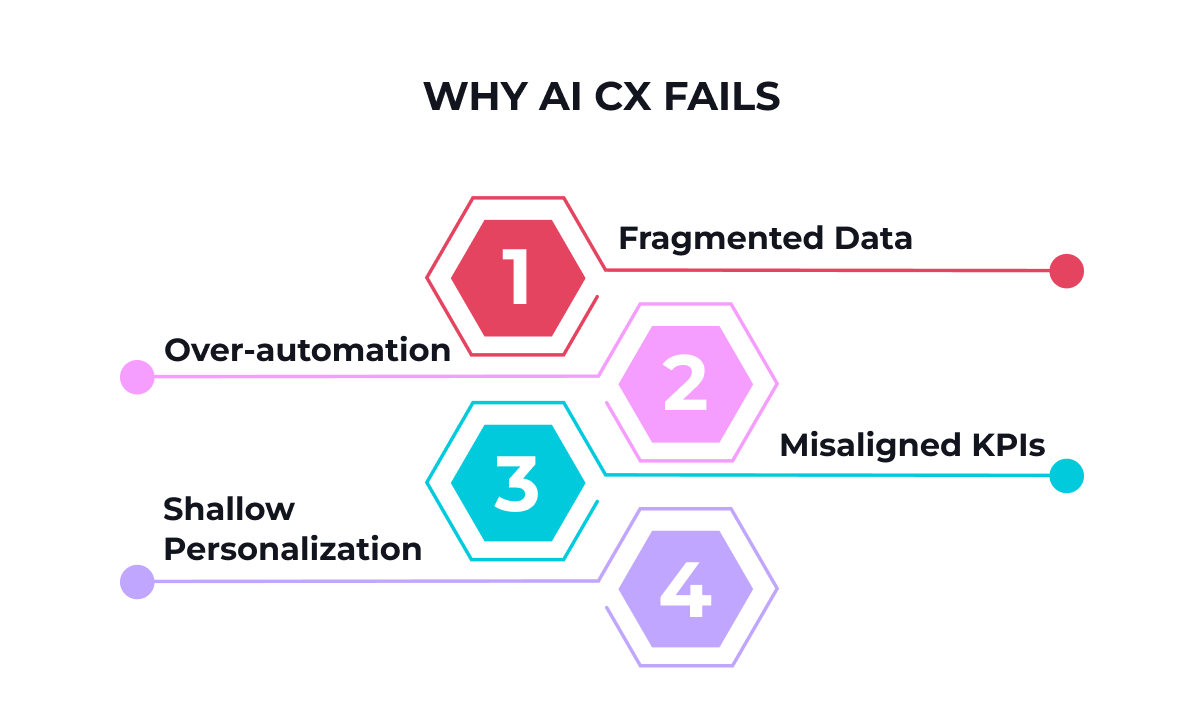
Data fragmentation remains a structural constraint for AI customer experience initiatives. According to industry research, only 4% of brands report fully integrated and available customer data, while many operate with partially connected systems. Without a complete customer view, AI systems struggle to deliver consistent personalization or actionable insights across channels.
In practice, fragmented data prevents AI from maintaining continuity across customer interactions. Context is lost between touchpoints, and each system interprets the customer independently rather than as part of a single journey. Creating a unified data foundation is required before AI can deliver consistent customer experience.
A support interaction may be handled without visibility into recent product usage, unresolved billing issues, or prior escalations. At the same time, marketing and service systems operate on different assumptions about customer intent and status. AI can respond quickly, but it cannot reason across these disconnected signals.
As a result, personalization becomes shallow and inconsistent. Recommendations fail to reflect the customer’s broader context, and automated responses prioritize efficiency over resolution. Instead of reducing customer effort, AI reinforces existing gaps between channels.
Companies often deploy AI to cut costs instead of solving customer problems. This flawed strategy helps explain why nearly one in five consumers report no benefit from AI-powered customer support, and why failure rates in customer-facing AI applications remain higher than in other AI use cases.
When faced with complex service issues, 70% of consumers across all generations prefer phone calls to reach human agents. When companies remove clear paths to human assistance, automated systems trap customers in repetitive loops. AI continues to respond within predefined patterns, even when the issue remains unresolved.
This automation trap becomes visible through user behavior. Mobile interfaces have seen a 667% year-over-year increase in so-called “rage clicks”, signaling repeated attempts to complete a task when automation fails to move the interaction toward resolution. Without reliable human fallback options, even minor issues can escalate into frustration or abandonment. To truly improve customer experience, companies need to balance AI efficiency with human empathy.
Internal dashboards may signal progress while customers experience stalled or unresolved interactions. Customer experience teams often optimize for efficiency metrics such as deflection rates, average handling time, or cost reduction, rather than for outcomes that reflect whether customer problems are actually resolved.
This misalignment becomes especially visible in AI-driven environments. When success is measured by reduced contact volume instead of resolution quality, automation is incentivized to block demand rather than address it. As a result, AI systems appear effective internally while customer effort increases across channels.
Industry research consistently highlights this gap. McKinsey found that few customer care leaders report satisfaction levels exceeding expectations, despite years of investment in digital tools. Efficiency gains alone do not translate into better customer experience.
Without shared KPIs across marketing, sales, and service functions, AI optimizes locally rather than across the end-to-end customer journey. Until customer outcomes replace deflection rates as the primary measure of success, AI will continue to optimize for internal efficiency rather than customer experience.
Traditional personalization responds to immediate signals. When a customer searches for a product, the system surfaces related content.Organizations still structure around products (28%) rather than customer segments (14%).
Simple segmentation creates fixed categories that do not adapt as customer context changes. AI recommendation engines optimize for engagement metrics rather than customer outcomes, and they typically operate within single channels or sessions rather than across the full customer journey.
AI personalization fails when it cannot distinguish between casual browsing and high-intent behaviors such as billing disputes or signs of churn. Without predictive models that account for behavior across channels and time, personalization remains reactive and surface-level.
Customer experience breaks when data, decisions, and teams operate in silos. Darwin connects them into unified systems.
A persistent gap exists between what AI systems are designed to optimize and what customers actually expect from their interactions. As a result, even technically advanced implementations often fail to reduce frustration or improve perceived experience.
Operational efficiency alone does not translate into customer loyalty. Automation can reduce handling times and operating costs, but it fails when context, emotion, or judgment are required.
88% of customers rate human-led interactions as satisfactory, compared to 60% for AI-driven ones. At the same time, 65% expect companies to understand their individual context, not just respond to requests.
This creates a structural gap. AI systems process inputs efficiently, but customer experience depends on how problems are interpreted, escalated, and resolved. When interactions feel generic or scripted, trust erodes regardless of speed.
Human agents adapt in real time, interpret intent beyond explicit input, and adjust responses based on situational nuance. Until AI systems are designed to support structured handoffs rather than replace human judgment, efficiency gains will mask underlying resolution failures.
AI processes explicit input but lacks mechanisms to interpret emotional state reliably. Sentiment analysis can flag keywords like "frustrated" or "urgent," but it misses exhaustion, anxiety, or resignation that don't map to obvious linguistic markers.
This limitation has measurable consequences:
The result: efficiency metrics improve while customer relationships degrade. Without mechanisms to account for emotional context, AI optimizes for speed and deflection rather than resolution quality.
Chatbots become problematic when deployed beyond their intended scope. Many companies apply chatbots across all interaction types instead of limiting automation to scenarios like order status checks, password resets, or FAQ responses.
Customers accept automated responses for simple, transactional requests. Issues requiring account-level decisions, billing disputes, or multi-step troubleshooting require human intervention.
A common failure point is the absence of timely human access. Chatbots that cannot identify their own limitations or provide clear escalation paths push customers into repetitive loops that increase effort across channels.
Effective customer experience design treats escalation as a functional requirement. Systems should detect complexity indicators such as repeated clarification attempts, sentiment shifts, or stalled multi-turn conversations, and route interactions to human agents with conversation history, account context, and prior attempts preserved.
Customer experience depends on how systems and workflows connect.
Darwin helps align data, decisions, and execution.
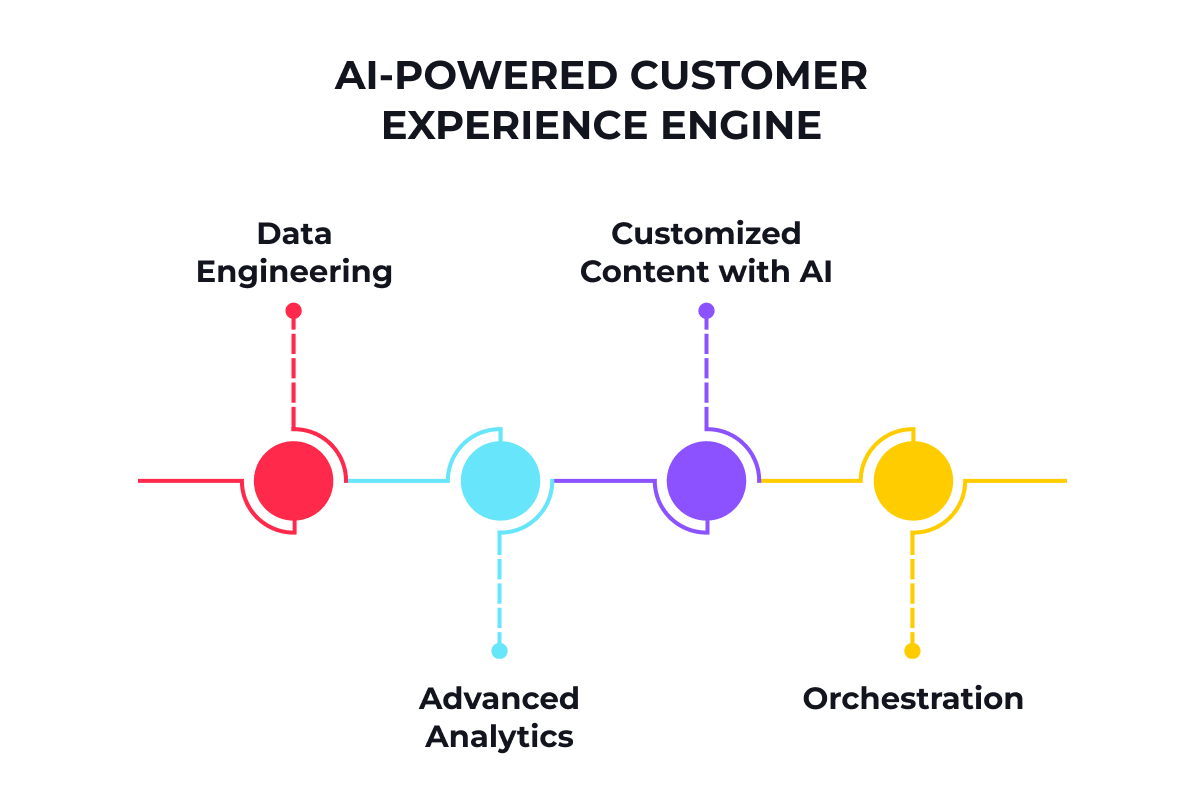
Building a scalable customer experience engine depends on how data, workflows, and decision logic connect across teams and touchpoints.
Any CX system breaks down without a shared customer record. Most organizations operate across dozens or hundreds of disconnected data sources spanning marketing, sales, support, and commerce. When these systems are not aligned, customer context fragments across channels.
A unified customer view connects behavioral, transactional, and service data into a single operational layer. This enables teams to act on history and intent rather than isolated events. APIs and integration layers (such as event-driven pipelines, ETL workflows, or customer data platform integrations) provide the mechanisms for aggregating data from both modern and legacy systems into a common structure.
Without this foundation, downstream systems operate on partial context. Personalization becomes inconsistent, handoffs degrade, and automated decisions contradict one another. High-performing teams treat customer data as shared infrastructure rather than a departmental asset. When marketing, sales, and analytics teams operate on disconnected data, this infrastructure work becomes critical.
For example, Cleo consolidated fragmented marketing data across Marketo, Salesforce, and analytics platforms with Darwin’s support, saving $50K in annual manual reporting costs and enabling real-time campaign optimization.
Propensity models calculate the likelihood of specific customer actions, from purchases to churn. Unlike descriptive analytics that report past behavior, propensity models estimate likely next customer actions based on observed behavior and historical data
Common applications include:
Generative AI supports the production of content variants based on customer context rather than static templates. Messages can incorporate signals from recent transactions, service interactions, and product usage, allowing responses to reflect current customer state rather than generic segments.
In practice, this requires controlled deployment. Generated content should be reviewed and governed by clear constraints, particularly in early stages. As governance and quality controls mature, generation can scale with reduced manual intervention while remaining aligned with brand, policy, and customer experience standards.
The value emerges when variation is driven by relevance rather than volume. Content adapts to customer context and intent, reducing repetition and improving continuity across channels.
Customer interactions span multiple channels and moments and require coordination to avoid overlap and repetition. Messages need to be sequenced and prioritized so that each interaction fits the customer’s current context and does not interrupt an unresolved journey.
This orchestration layer evaluates which message, if any, should be delivered based on priority rules, recent interactions, and channel load. It manages campaign timing, priority conflicts, and inclusion logic across channels, determining which interactions can coexist and which should be delayed or suppressed to prevent message collisions.
At this level, analytics signals are connected directly to content delivery logic. Interactions are triggered by customer behavior and context, not fixed campaign schedules.
The way customer experience systems are designed is changing. As Mike Clifton, Co-CEO at Alorica, describes:
“What fascinates me most about AI is how it's completely changing how we think about the customer experience. In this industry, we used to define a process, map the customer journey, process-enable tasks, and then build a system to support them. Now, instead of building a linear path, we're spotting patterns across thousands of past interactions to anticipate what a customer needs the moment they make contact.”
AI no longer operates at the tool level. It shapes how interactions are sequenced, adapted, and escalated across the customer journey. Instead of supporting predefined flows, AI influences decision points in real time, based on accumulated context rather than isolated events.
Organizations that succeed here redesign how context moves across systems and teams. They treat escalation, prioritization, and handoff logic as part of the journey architecture rather than downstream exceptions. The focus shifts from optimizing individual touchpoints to managing how decisions are made across the full experience.
Interaction sequencing has a direct impact on customer experience. A European telecom stopped all marketing campaigns to customers with open complaints or unresolved service issues. This adjustment raised their Net Promoter Score to match the market leader and improved both cross-sell and churn outcomes.
Core principle: prioritize customer state over campaign schedule. Journey-focused systems evaluate current context before triggering outbound interactions.
Predictive systems shift customer service from reactive response to proactive intervention. AI identifies patterns that signal customer needs before customers articulate them explicitly.
Instead of waiting for customers to contact support about recurring issues, systems can flag usage anomalies, detect billing inconsistencies, or identify product adoption gaps that typically precede churn. This enables outreach before frustration escalates into disengagement.
Wizehire achieved a 26% reduction in lead cost by integrating AI into their funnel optimization, enabling 3x faster response times through predictive lead scoring and automated routing.
AI systems break down when they are isolated from human processes. Stable customer-facing experiences depend on how well internal operations across support, product, and service teams are connected.
AI is most effective when embedded into existing workflows. Routine, repeatable requests can be handled automatically, while complex or ambiguous cases remain with human teams. This separation of responsibility prevents overload on both sides.
Running complex AI across marketing, product, and support? Darwin aligns data flows, routing logic, and execution.
When AI outputs are aligned with human decision-making, handoffs become clearer and resolution quality improves. Instead of optimizing individual steps, teams manage the full path from signal to outcome, reducing handoff failures and unnecessary customer effort.
Human involvement remains critical in customer experience, even as AI capabilities advance. The balance between automation and human interaction is not about choosing one over the other. It requires designing systems with clear responsibility boundaries, where each component performs the work it is best suited for.
Well-designed systems recognize their limits and escalate interactions to humans at defined thresholds. Escalation is required in high-risk situations, emotionally charged interactions, open-ended issues, and cases that require judgment or negotiation.
During handoff, conversation history and relevant customer data must transfer with the interaction. Preserving context turns escalation into a resolution mechanism rather than a system failure.
As automation absorbs routine requests, human agents increasingly handle complex and ambiguous cases. This shift changes how frontline teams need to be trained.
Effective training focuses on interpreting system signals, validating AI-supported recommendations, and intervening when automation reaches its limits. Simulation of AI-to-human handoffs helps reduce resolution gaps and handoff errors.
The goal is not to make AI appear human. Systems should support human judgment, not attempt to replicate it.
Automation performs best when assigned to repetitive, data-driven tasks. Humans remain responsible for discretion, interpretation, and trust-building. Clear separation of responsibilities improves resolution quality and reduces operational strain.
Design decisions at the system level determine whether automation supports or undermines experience. In the case of VTS, Darwin redesigned site architecture to improve usability for commercial real estate audiences, balancing self-service automation with clear paths to human sales support.
Strong customer experience depends on how decisions are made across systems.
Darwin helps define that logic.
Darwin works with B2B companies that need customer data, workflows, and decision logic to operate as connected systems.
Our work focuses on three areas:
We connect fragmented customer data across marketing, sales, support, and product systems into unified operational layers. This includes building integration pipelines, establishing shared customer records, and ensuring context moves cleanly between platforms.
We design escalation logic, routing rules, and handoff mechanisms that preserve customer context. This means defining when AI handles requests, when humans intervene, and how information transfers between them without requiring customers to repeat themselves.
Marketing, support, and product teams often operate on different definitions of customer state, priority, and success metrics. We help establish shared logic so systems act consistently without conflicting data.
The result? Infrastructure that allows AI to support customer interactions without creating new points of failure.
If your AI implementation improves internal metrics but customers still experience repetitive interactions and broken handoffs, the issue is system architecture.
Darwin assesses current data flows, identifies integration gaps, and builds the technical foundation required for AI customer experience to work reliably.
Ready to move from AI experiments to reliable CX infrastructure? Darwin helps you get there.
Q1. How can companies improve their AI-powered customer experience?
Companies need unified customer data that connects behavioral, transactional, and service information across platforms. This requires integration layers that preserve context during handoffs, routing logic that escalates appropriately, and workflows where AI supports human judgment rather than replacing it. The focus should be on infrastructure that allows teams to act on complete customer context instead of fragmented signals.
Q2. Why do many AI customer experience implementations fail?
Most failures stem from treating AI as a tool problem rather than a systems problem. Customer data remains fragmented across marketing, sales, and support platforms. Routing logic lacks context preservation during escalations. Teams optimize for deflection rates rather than resolution quality. AI operates independently from human workflows instead of supporting them. Without addressing these structural issues, even sophisticated AI creates new problems rather than resolving existing ones.
Q3. What is the importance of human touch in AI-powered customer service?
Human involvement remains critical because AI processes explicit input but lacks mechanisms to interpret emotional state, situational nuance, or complex judgment reliably. Customers accept automated responses for transactional requests but require human agents for high-risk situations, emotionally charged interactions, and cases requiring negotiation. Effective systems recognize these thresholds and route appropriately with full context transfer, treating escalation as designed functionality rather than system failure.
Q4. How can businesses create a balance between AI efficiency and human empathy? Balance requires clear separation of responsibilities. AI handles repetitive, data-driven tasks where speed and consistency matter. Humans manage discretion, interpretation, and trust-building where judgment is required. Systems should detect complexity indicators (repeated clarification attempts, sentiment shifts, stalled conversations) and route to human agents with conversation history, account context, and attempted solutions intact. This division of labor improves resolution quality without creating operational strain.
Q5. What are the potential benefits of successful AI implementation in customer experience?
Successful implementation reduces repetitive work for human agents, allowing focus on complex cases that require judgment. Customers experience fewer handoff failures and repetitive interactions when context preserves across channels. Teams operate from unified customer data rather than conflicting assumptions. The operational benefit is predictable system behavior rather than efficiency gains that mask unresolved problems. Organizations that treat AI customer experience as infrastructure work see sustainable improvements in both resolution quality and team productivity.
Contact Darwin today for a custom SEO strategy that combines the best automation tools with proven tactics to dominate Google and AI search results.
Talk to us