A practical guide to what vibe coding is and where it fits in marketing operations. Covers tools, real use cases, and the limits of the approach.
Quick Answer:
In marketing, vibe coding means describing the tool or page you need in plain language and letting AI generate the functional code. Common applications include landing pages, campaign dashboards, lead qualification tools, email layouts, and internal automation scripts. Tools most used by marketing teams include Bolt and Lovable for page building, Cursor and Claude Code for structured development, and Zapier Agents for workflow automation. The approach works for self-contained tools with limited integration requirements. Production systems, CRM writes, and security-sensitive infrastructure still require engineering involvement.
Vibe coding gives marketing teams a faster path to internal tools, campaign pages, and automation scripts without waiting for engineering resources. It works when the task has defined inputs, predictable outputs, and limited integration with production systems.
To apply it effectively:
The approach expands what marketing can execute independently. Developer oversight remains required for infrastructure, security, and complex integrations.
Vibe coding describes building software by explaining the intended result in plain language and allowing AI to generate the code.
In February 2025, the term "vibe coding" gained wider attention after Andrej Karpathy, co-founder of OpenAI and former AI leader at Tesla, referenced it publicly and gave a clear name to an approach that had already been emerging: generating working code through natural language instructions.
Karpathy also described the idea as “fully giving in to the vibes,” meaning the user focuses on the outcome while the system handles implementation details.
Programmer Simon Willison made an important distinction. If an LLM writes the code and you review, test, and understand every line, that is AI-assisted development. Vibe coding implies a different level of delegation, where the internal structure of the code may remain opaque to the user.
For marketing teams, the difference determines who owns the tool and who carries the risk. It affects how tools are built, how much oversight is required, and where responsibility remains inside the workflow.
Vibe coding refers to a development practice where users describe what they want to build using natural language and AI generates the code. The approach prioritizes creativity and intent over technical syntax. A key characteristic is accepting AI-generated output without necessarily understanding every line of the underlying code.
“Vibe coding is describing a tool you want in plain language and letting AI draft the code for you.” – Impact Plus
The process follows a conversational pattern. A user describes a goal in plain language: a dashboard, a form, a script. The AI tool generates functional code. The user reviews the output, tests it, and provides feedback. The cycle repeats until the result meets requirements. The programmer’s role shifts from writing code to guiding, testing, and evaluating AI-generated output.
Large language models (LLMs) like ChatGPT, Claude, and OpenAI’s Codex serve as coding assistants, making suggestions and automating repetitive development tasks. Y Combinator reported that 25% of companies during the Winter 2025 batch had codebases that were 95% AI-generated. Popular vibe coding tools include GitHub Copilot, Claude Code, Cursor, Bolt, Lovable, and Replit Ghostwriter.

Wondering how vibe coding fits your current marketing setup? Darwin can help you find out.
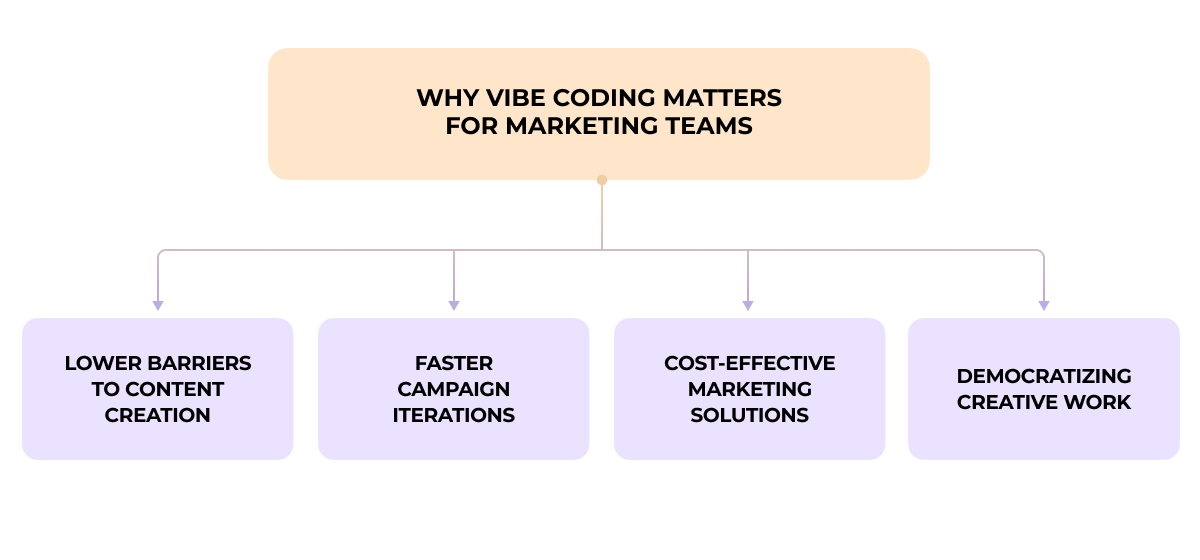
Marketing teams work with a constant capacity gap. Ideas and campaign logic move faster than engineering availability. Tools such as attribution dashboards, lead scoring models, internal calculators, and campaign utilities often require development support that marketing does not control directly. This dependency slows execution and limits iteration speed.
Vibe coding reduces engineering load for a clearly defined set of tasks. Marketing teams can build working landing pages, dashboards, lightweight automation scripts, and internal tools on their own. Ownership expands at the execution level, while core architecture, security-sensitive systems, and production infrastructure remain within engineering responsibility.
“Businesses using vibe marketing will operate at 10–20x the pace and efficiency.” – MySignature
The impact is operational: faster testing cycles, shorter feedback loops, and greater control over experimentation without increasing headcount.
Traditional development requires technical expertise that most marketing teams do not have in-house. Campaign pages, interactive tools, and internal dashboards often depend on engineering time. With natural language prompts and low-code interfaces, marketers can build and modify these assets independently. Ownership of execution increases, while engineering remains responsible for production infrastructure and system stability.
When a prototype can be built in hours, teams can test ideas the same week they are proposed. Teams validate ideas earlier, discard weak concepts faster, and move strong concepts into market testing sooner. Shorter build cycles lead to tighter feedback loops and more controlled experimentation.
Y Combinator CEO Garry Tan noted that a team of 10 engineers using vibe coding tools can now deliver work that previously required 50 to 100 engineers. For marketing teams, this shows what changes when development time drops. A campaign dashboard, lead scoring calculator, internal reporting tool, or landing page generator no longer has to wait in a developer queue. For a defined scope of tasks, marketing can build and test functional versions independently.
Small teams feel this most clearly. They can ship internal tools without hiring additional developers or paying agencies for every iteration.
Vibe coding moves part of software creation closer to the people who shape marketing strategy. When a team can describe the logic of a tool or campaign in plain language and generate a working version quickly, the distance between idea and execution shortens. This does not remove the need for engineering, but it changes who can initiate and test internal tools. Core architecture and production infrastructure remain under engineering ownership. Clearly scoped marketing tools can be built and iterated by the marketing team.
The strongest marketing use cases have three traits: defined inputs, predictable outputs, and limited dependency on production systems.
The Cleo case shows how infrastructure requirements shape marketing execution. When GDPR requirements tightened in European markets, the priority was maintaining compliant analytics while preserving reporting accuracy. Darwin implemented Google Consent Mode, BigQuery modeling, and GA4 configuration to keep reporting accurate under updated privacy rules.
In marketing environments with similar integration demands, automation tools such as Zapier connect CRM systems, campaign platforms, and reporting workflows through defined integration logic.
Social content is an early example. Teams use prompt-driven workflows to maintain brand voice and generate variations at speed.
Landing pages and microsites follow the same logic. Marketing teams describe the structure, logic, and basic data handling in plain language and generate functional versions that can be tested quickly. What previously required weeks of coordination can move to deployment in days.
Email production has also shifted. Tools such as Stripo and BeeFree allow teams to generate campaign layouts and adjust messaging through no-code interfaces. Content and structure can be adapted to audience parameters without engineering involvement.
The same applies to lightweight internal tools. Attribution calculators, event dashboards, or lead qualification logic can be built as functional utilities and embedded into existing pages when the integration scope is controlled.
Workflow automation is another practical layer. Platforms such as Zapier Agents connect multiple marketing systems through prompt-based logic, handling enrichment, routing, monitoring, and variation testing without custom code configuration.
A working prototype lets you test with real users, see real numbers, and decide what deserves budget.
Tool selection depends on the task type and the user’s technical comfort level. No single platform covers the full range of marketing needs.
For Interface and Page Building
For Structured Development
For Prompt Development and Content Systems
How to Get Started with Vibe Coding in Marketing
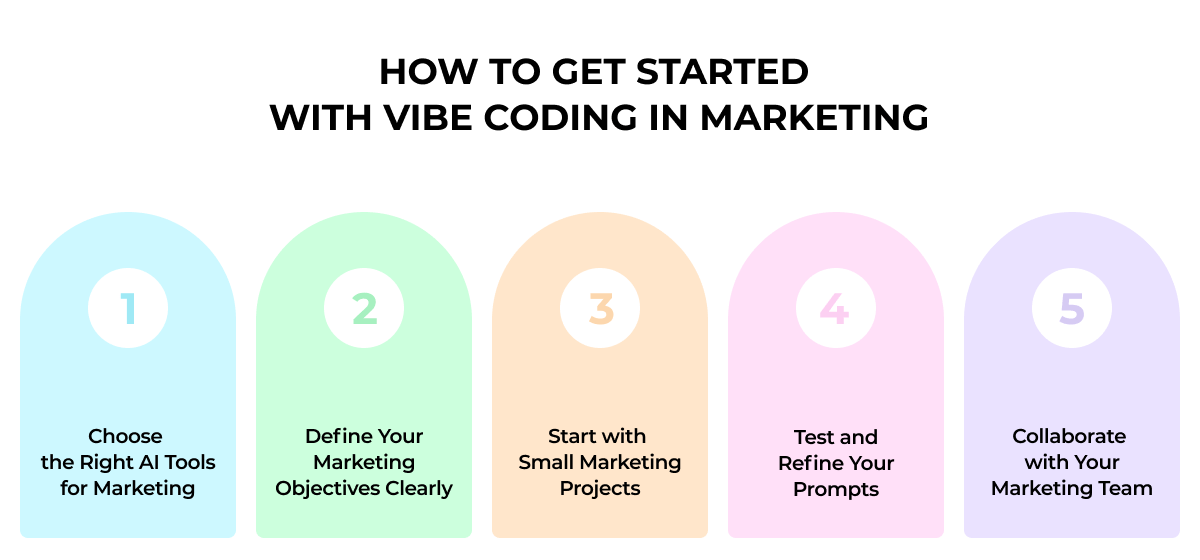
Getting started with vibe coding does not require a technical background. The limiting factor is identifying the right tasks and structuring requests clearly enough for AI to produce useful output.
Begin with tools that match your task and technical comfort level. Use no-code builders for interfaces and landing pages, conversational AI for prompt development, and automation platforms for system connections. Move to code editors only when you need more control over generated output.
Before building anything, identify a specific marketing problem to solve: lead scoring, brand audits, campaign analytics. Write requirements in plain language: what the tool should do, who will use it, what inputs it needs, and what a successful output looks like. This clarity prevents AI from adding unnecessary complexity.
The best starting point is the backlog: projects stuck in the queue because they fall below the threshold for developer time. Spend an hour building something simple: a personal landing page, a team directory, a basic calculator. Time-box experiments. One hour today, one project this month.
Define four things before writing a prompt: what you are building, who it is for, what it must do, and what “done” looks like. This reduces unnecessary revisions.
Document working prompts and reuse them. Over time, this creates a tested internal library that reduces variability and speeds up future builds.
Vibe coding delivers efficiency when applied to clearly defined tasks. Used without guardrails, it introduces operational risk.
AI generates what it interprets from the description it receives. Vague requirements produce vague code. The output may be functional but miss the actual goal. Define inputs, outputs, constraints, and edge cases before prompting. Treat the prompt as a specification document.
Code that no one on the team understands becomes a liability as soon as it needs to change. Tools built quickly often ship without documentation, clear naming, or predictable internal logic. When updates are required, no one knows where to start. If a team plans to use a tool beyond a short experiment, the AI should explain how it structured the solution, the prompt that generated it should be saved, and a developer should review the setup before it connects to real customer information.
Marketing teams work with form submissions, lead records, and behavioral signals from campaigns. When a tool built through vibe coding connects to a production database or collects user input, it carries the same responsibility as any customer-facing system.
AI does not add access controls or compliance safeguards on its own. Those decisions must be defined before launch or reviewed by someone with technical oversight. Otherwise, risk shifts quietly from engineering to marketing.
Tools created through vibe coding are often designed for a specific task. Tension appears when a prototype begins to function as core infrastructure.
A dashboard that performs well for one campaign may struggle under ten. Before moving anything into production, the underlying setup should be evaluated for load, stability, and long-term use.
A practical guideline is scope. Marketing teams can own tools such as landing page generators, campaign dashboards, internal calculators, or automation scripts where the logic is limited and the impact is contained. Once a tool writes to your CRM, modifies billing logic, updates product databases, or affects official reporting, engineering review is required before launch.
Not sure where vibe coding ends and real infrastructure begins? Darwin helps you draw that line.
Marketing teams can build faster with vibe coding. That speed works only when reporting, routing, and measurement stay consistent.
Darwin ensures that marketing-built tools operate inside a structured environment. We align lead routing, attribution logic, reporting standards, and access control so that new assets integrate cleanly with existing workflows. This prevents inconsistencies in reporting and eliminates the need for post-launch corrections.
For marketing teams, this means fewer delays between launch and measurement. New tools feed directly into CRM, dashboards reflect accurate performance, and revenue reporting remains consistent. Execution accelerates without creating integration debt.
Marketing gains speed. Leadership retains control and visibility.
Q1. What exactly is vibe coding in the context of marketing?
Vibe coding is a development approach where marketers describe the desired outcome in plain language and AI generates the functional code. It allows non-technical teams to build landing pages, dashboards, and simple internal tools without writing code line by line.
Q2. How can vibe coding benefit marketing teams?
It reduces dependency on engineering for low-complexity marketing tasks. Teams can prototype and launch defined tools faster and lower internal tooling costs when integration scope is controlled.
Q3. What are some practical applications of vibe coding in marketing?
Typical use cases include campaign dashboards, lead qualification tools, landing pages with defined logic, email layout generation, internal calculators, and automation scripts where requirements are clearly scoped.
Q4. How can marketers get started with vibe coding?
Start with a contained task from the backlog. Choose a user-friendly tool such as Bolt or Lovable. Define inputs, outputs, and constraints before prompting, and expect several iteration cycles before the result is ready for use.
Q5. Is vibe coding replacing traditional programming in marketing?No. It expands what marketing teams can execute independently. Production systems, complex integrations, and architectural decisions remain with engineering. Clear task boundaries determine where each approach fits.
Contact Darwin today for a custom SEO strategy that combines the best automation tools with proven tactics to dominate Google and AI search results.
Talk to us