
AI is reshaping how marketing teams measure performance. Learn which analytics trends, tools, and measurement frameworks matter most in 2026.
Quick Answer:
Marketing analytics in 2026 relies on composite measurement. MMM, multi-touch attribution, and incrementality testing work together because last-click models and static dashboards miss how AI-influenced buying decisions unfold. Clean data architecture and governed KPI definitions support operating control and operational execution.
AI increasingly participates in how marketing operates. It influences budget allocation, campaign orchestration, search discovery, and customer interaction flows. This shift requires infrastructure built for speed, systems designed for complexity, and teams capable of turning insights into business decisions.
By the end of 2026, AI agents are expected to handle 20% of customer service interactions. Advertising revenue from AI and LLM search may reach $26 billion within its first five years in the US. These changes already affect how teams plan, evaluate channels, and structure reporting.
Dashboards built for static reporting and last-click attribution miss cross-channel impact. Analytics now includes AI-driven insights, conversational queries, and composite modeling approaches.
This article outlines the trends shaping 2026 and explains how to design analytics that supports multi-platform discovery, agent-driven workflows, and complex customer journeys.
AI is changing marketing analytics in two ways: how brands get discovered and how campaigns execute without human input.
First, search and discovery no longer happen only in traditional search engines. AI-driven platforms generate answers, summarize content, and surface brands in new formats. This changes how traffic is distributed and how attribution is tracked.
Second, AI systems now participate directly in execution. They allocate budget, adjust bids, trigger workflows, and support campaign coordination. In some cases, they complete tasks without manual approval.
Many teams still rely on reporting models that were built for slower, human-driven processes. As execution accelerates, reporting logic must adapt as well.
Early AI adoption in marketing focused on tools like ChatGPT that supported content creation, including blog drafts and email subject lines. The focus has expanded. AI systems now participate in campaign execution, budget allocation, and optimization workflows.
By 2028, 33% of enterprise software applications are expected to include agentic AI, and 15% of daily work decisions may be handled autonomously. Programmatic platforms already adjust bids in milliseconds. AI systems increasingly influence orchestration and planning tasks that previously required coordinated team effort.
For marketing teams, the discussion now centers on responsibility and control. High-frequency, low-risk tasks align well with automation. Brand-sensitive content benefits from review layers. Strategic decisions require human context. Compliance and ethics demand structured oversight. Creative direction remains human-led.
Search behavior is shifting toward AI-driven platforms, and referral patterns are changing. ChatGPT reaches over 800 million weekly users. Google’s Gemini app has surpassed 750 million monthly users. AI Overviews appear in at least 16% of searches. In some cases, brands already receive meaningful referral traffic directly from AI-generated responses.
At the same time, this traffic is harder to forecast. When models update how they generate answers, the sources they reference can shift. Referral volumes may increase or decline within a short period, which complicates channel planning and capital efficiency.
To remain discoverable, brands need clear entity definitions, content structured for extraction, and presence on multiple platforms. Large language models reference Reddit threads, YouTube videos, review platforms, and industry publications. Content must function as standalone, extractable sections. Clear headings help models connect answers to specific questions.
AI agents participate directly in campaign execution. They evaluate inputs, allocate budgets, trigger workflows, and adjust targeting logic without constant manual review.
These systems break tasks into defined steps, execute them, and adjust based on new signals. This shortens reaction time and improves coordination between channels.
In practice, this affects customer engagement, campaign management, and performance tracking. AI-driven processes personalize messaging, update targeting parameters, and reallocate spend in near real time. Thousands of micro-decisions can run simultaneously, reducing manual workload for marketing teams.

Not sure your analytics infrastructure is ready for AI-driven execution? Darwin can assess and fix that.
Sixty-five percent of CMOs expect AI to significantly reshape their role within the next two years. Yet only 32% believe major updates to their skill set are required. By 2027, limited AI literacy is projected to become one of the leading factors behind CMO turnover in large enterprises.
Skills are only part of the issue. Many marketing infrastructures rely on monthly reporting cycles and delayed data consolidation, limiting real-time orchestration. Information often remains fragmented between CDPs, CRMs, and automation platforms. Inconsistent definitions, incomplete customer records, and compliance gaps reduce reliability.
When foundational systems lack alignment, AI adoption slows. Advanced analytics cannot operate effectively on fragmented infrastructure. The constraint lies in system design, integration, and governance.
In 2026, marketing analytics tooling shifts from periodic reporting to live execution support. Teams prioritize dashboards that update from ad platforms and GA4, natural language querying in BI, integration standards like MCP, and privacy-safe collaboration through data clean rooms.
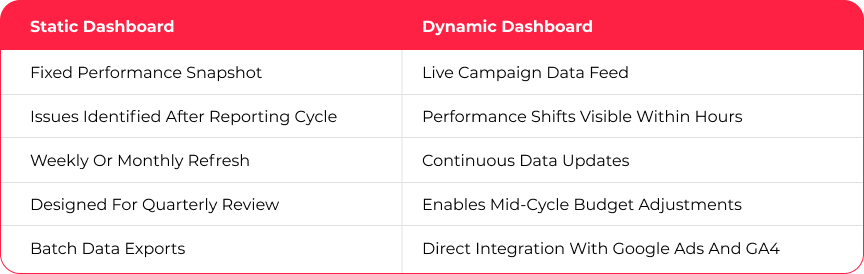
Static dashboards reflect performance at the time of report generation. When budgets shift mid-cycle or targeting changes during the week, issues surface only in the next reporting cycle.
Dynamic dashboards connect directly to ad platforms and GA4, showing spend and conversion changes the same day.
If a paid search campaign loses conversion rate on Wednesday, a weekly report reveals it the following Monday. A live dashboard surfaces the drop immediately, allowing the team to pause the ad group and intervene before inefficiency compounds.
Darwin helps marketing teams move from static reporting to live measurement infrastructure.
Conversational analytics enables teams to query reporting systems in natural language instead of writing SQL or navigating BI filters. This reduces analyst dependency and shortens the time between question and decision.
According to Gartner’s 2026 forecast, AI-driven insights are expected to account for 60% of new analytics spending, with conversational interfaces accelerating BI adoption.
Metric consistency remains critical. If revenue or customer acquisition cost differ across systems, identical questions return conflicting answers.
A media buyer can ask which campaigns drove the most revenue last month and receive a ranked breakdown instantly, without opening a BI tool or waiting for analyst support.
Model Context Protocol defines how AI systems connect to external tools and data sources through shared integration standards.
For marketing teams, this means AI systems can access CRM stages, campaign data, brand assets, and support history without building a custom integration for every new tool.
Examples:
Data clean rooms enable companies to analyze shared datasets without exposing personally identifiable information. Access rules define who can combine data, what can be analyzed, and which outputs can be exported.
They are used when direct cross-platform tracking is limited. Instead of sharing raw user-level data, partners compare aggregated signals in a controlled environment.
They are commonly used to:
Clean rooms strengthen first-party measurement and reduce reliance on third-party identifiers. They formalize collaboration under shared governance and make privacy-compliant analytics part of long-term infrastructure.
Platforms such as Google Ads, Meta Ads, and Amazon Ads operate within their own ecosystems. Targeting, delivery, and reporting stay inside platform infrastructure, limiting cross-channel transparency.
To build consistent reporting, teams reconcile platform-reported metrics with CRM data and warehouse environments such as BigQuery or Snowflake. Independent attribution and a validation layer help confirm impact beyond platform dashboards.
"Brands can't afford fragmented decision-making. When your media, CRM, and analytics engines are working from different truths, you lose speed, efficiency, and relevance."
Jed Hartman, President of Activation Partnerships, Zeta Global
The global marketing analytics market is expected to exceed $13 billion by 2030, reflecting sustained investment in advanced measurement and integration tools.
Standalone dashboards such as Google Analytics do not provide full cross-channel reconciliation. Teams consolidate first-party signals, media platform exports, and revenue data into warehouse models, then visualize results in tools such as Looker, Tableau, or Power BI for finance review.
Darwin helps marketing teams turn fragmented platform data into consistent, revenue-linked reporting.
Last-click attribution is replaced by a composite approach that combines Marketing Mix Modeling, user-level attribution, and incrementality testing. This combination distributes credit across the funnel and validates causal impact instead of assigning full value to the final touchpoint.
A customer may see a LinkedIn ad, click a Google search result, watch a YouTube video, and convert after receiving an email. Last-click assigns full credit to the final interaction, leaving earlier influences unmeasured.
More than 70% of customers interact with a brand several times before converting. They move between devices, channels, and sessions. A single-touch model compresses this sequence into one event, which distorts channel comparisons and skews budget allocation.
Marketing Mix Modeling in 2026 quantifies long-term channel contribution and incremental revenue impact using aggregated time-series data. It supports strategic budget allocation when user-level tracking becomes less reliable due to privacy restrictions.
Signal loss and privacy restrictions reduce the reliability of user-level attribution. Marketing teams respond by increasing investment in Marketing Mix Modeling. Nearly half of US marketing professionals, 46.9%, plan to increase investment in Marketing Mix Modeling in 2026.
"Marketing measurement has evolved beyond answering 'what worked' to an always-on capability linking marketing and operational investments to create measurable enterprise value." Doug Brooks, Chief Client Officer, Ipsos MMA
Organizations combine MMM with first-party analytics and attribution systems. Attribution supports campaign-level optimization. MMM informs longer-term budget planning and channel mix decisions. Used together, these approaches reduce reliance on platform-reported metrics and clarify revenue drivers.
Incrementality testing divides audiences into test and control groups to isolate the effect of a campaign. The test group is exposed to the marketing activity. The control group is not. Comparing outcomes between these groups reveals the incremental impact.
This approach addresses a known limitation of platform attribution. Platform-reported conversions often include outcomes that would have occurred without paid exposure.
A well-known example comes from Uber. A three-month incrementality test found that Meta ads generated little incremental lift, leading the company to reduce spend and avoid approximately $35 million in wasted investment.
Incrementality testing provides causal validation. It clarifies which channels generate net-new results and which primarily capture existing demand.
What Is Triangulation in Marketing Measurement?
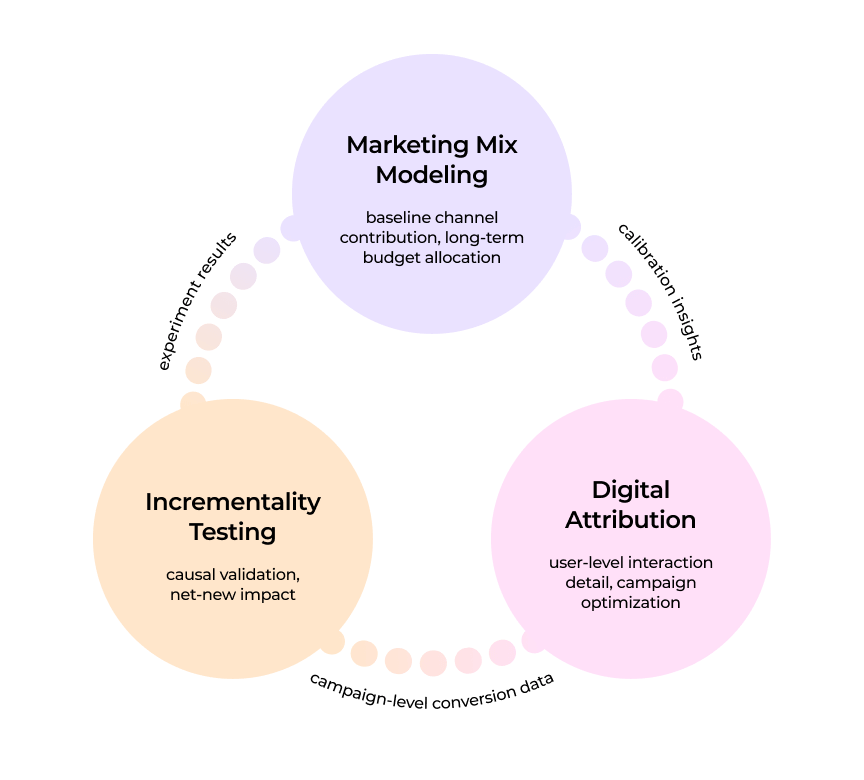
Triangulation combines Marketing Mix Modeling, attribution, and incrementality testing into one coordinated measurement system. Each method answers a different question, and together they reduce reliance on platform-reported metrics.
No single method answers every strategic and tactical question. MMM supports long-term budget allocation. Attribution maps user-level paths. Incrementality testing confirms causal lift through controlled experiments.
Each approach has limits when used independently. MMM operates at an aggregate level. Attribution provides interaction detail but may overstate contribution. Incrementality testing delivers causal validation but does not scale across all campaigns.
Triangulation connects these approaches into a coordinated system. MMM defines baseline channel contribution. Incrementality experiments validate net-new impact. Attribution models are calibrated using insights from MMM and experimental results.
When Meta claims 50% of conversions but only 30% of customers report Meta as their discovery channel, triangulation surfaces that discrepancy.
Struggling to connect attribution, MMM, and incrementality testing into one measurement system? Darwin can help.
Marketing analytics in 2026 requires KPI ownership, governed reporting logic, and infrastructure designed for decision-layer validation.
Business questions determine metric selection. Revenue, retention, and margin impact take priority over engagement indicators. CAC, marketing ROI, and customer lifetime value reflect financial contribution more directly than traffic or click-through rates.
KPI definitions require documented calculation logic, data source alignment, and ownership. Time horizon and review cadence must match budgeting cycles. Metrics that do not influence operating decisions are removed from core reporting.
Only 23% of marketers report confidence in their KPI selection. Ambiguous definitions often lead to reporting misalignment later.
Align Stakeholders Before Dashboard Development
Dashboard design follows stakeholder alignment. Metric priorities, reporting frequency, and decision triggers are defined before infrastructure is built. Reporting gaps frequently originate in misalignment around metric logic and decision use.
Early review of reporting prototypes surfaces definition conflicts and approval risks. Feedback at this stage prevents rebuild cycles and keeps measurement aligned with budgeting priorities.
Over-automation often occurs when boundaries are not defined in advance. Decisions about which workflows remain manual determine long-term brand consistency and customer trust.
AI increases the speed and volume of campaign decisions. Human judgment defines context, prioritization, and trade-offs. Strategic oversight and customer experience perspective remain central in budget and messaging decisions. Data outputs require interpretation before allocation changes are made.
Answer Engine Optimization focuses on brand visibility inside AI-generated responses. Visibility is reflected in brand mentions, citations, and entity references across AI systems.
Key signals include:
Darwin helps marketing teams align KPI definitions, attribution logic, and reporting structures with finance from the start.
In 2026, marketing analytics teams need full ownership of how performance is defined, validated, and used in decision-making.
Dashboard configuration and query writing are baseline capabilities. The differentiator is interpretation.
Strong analysts evaluate data reliability, identify methodological gaps, and articulate trade-offs relevant to risk and resource prioritization.
Analytical reasoning and communication enable teams to interpret AI-generated outputs and translate them into clear operational direction.
Metric definitions require named ownership and documented calculation logic. Version control, assumption tracking, and periodic review maintain consistency across reporting cycles. Unmanaged KPI shifts introduce ambiguity and distort performance evaluation.
Channel mix and bidding models change throughout the year.
Analytics processes must support KPI refinement, scenario analysis, and validation without rebuilding infrastructure.
Review cadence ensures measurement evolves with execution conditions.
Measurement fails when tracking, attribution, and KPI logic drift apart. Darwin realigns the system before optimization begins.
The process begins with reviewing tracking architecture, attribution logic, and metric definitions. Inconsistent data flows and misaligned KPIs are corrected before advanced modeling is introduced.
Engagement scope covers:
Tracking misalignment blocks reliable measurement. When ABC Fitness Solutions approached Darwin with critical Google Analytics configuration issues, the team lacked a reliable view of customer behavior and campaign performance. After resolving tracking gaps and integrating third-party tools, user engagement increased 24% and campaign effectiveness improved 15% within six months.
When tracking and KPI logic are governed, analytics becomes a control system that sustains operating control.
Still reporting activity instead of impact? Darwin builds measurement infrastructure that drives real budget decisions.
Q1.What are the main marketing analytics trends in 2026?
In 2026, marketing analytics centers on AI-driven execution, composite measurement models, conversational BI, privacy-safe collaboration, and KPI governance.
Q2. What replaces last-click attribution in 2026?
Last-click is supplemented by multi-touch attribution, Marketing Mix Modeling, and incrementality testing. These approaches distribute credit across interactions and validate true channel impact.
Q3. Why is Marketing Mix Modeling gaining importance?
Signal loss and privacy restrictions reduce user-level tracking reliability. MMM quantifies channel contribution using aggregated spend and outcome data.
Q4. What is triangulation in marketing measurement?
Triangulation combines MMM, attribution models, and incrementality testing. Each method answers a different measurement question, reducing dependence on platform-reported metrics.
Q5. How does AI change marketing analytics?AI increases execution speed in bidding, targeting, and workflow automation. Analytics shifts from reporting to monitoring, validation, and allocation oversight.
Contact Darwin today for a custom SEO strategy that combines the best automation tools with proven tactics to dominate Google and AI search results.
Talk to us







.avif)