Learn how to build automated renewal workflows that detect churn signals early, reduce manual tracking, and improve B2B customer retention.
Quick Answer:
Automated renewal workflows use CRM-based triggers, customer health signals, and timed email sequences to manage contract renewals in a structured way. When renewal milestones approach or engagement drops, the workflow triggers alerts, tasks, or outreach for the responsible teams.
This allows companies to detect renewal risks earlier, coordinate internal actions, and maintain consistent communication throughout the renewal cycle.
• Renewal automation. Automated workflows replace spreadsheet tracking with CRM-triggered sequences based on contract timelines and customer behavior.
• Churn reduction. Companies using renewal automation report churn reductions above 15% by catching at-risk signals early.
• 6-step setup. Define contract fields, map health signals, build templates, configure timing triggers, add branching logic, and test with pilot accounts.
• Segmentation. Enterprise clients receive high-touch executive engagement, while lower-tier accounts follow structured digital renewal paths.
• Balance matters. Automation handles routine tasks while teams manage negotiations, escalations, and relationship-driven renewal conversations.
Automated renewal workflows replace reactive spreadsheet tracking with a structured system that detects renewal risks early and supports targeted customer outreach. When configured correctly, renewal automation helps teams manage contract timelines, monitor engagement signals, and coordinate renewal actions across departments.
Subscription businesses are growing 4.6 times faster than the S&P 500, and every contract that slips through the cracks costs real revenue. Automated workflows can reduce churn by more than 15% while allowing your customer success team to focus on relationship-driven work that moves accounts forward.
Many teams still manage renewals manually, juggling spreadsheets, calendar reminders, and last-minute follow-ups that quietly erode revenue. Setting up renewal automation usually requires minimal engineering support and can significantly improve how renewal processes operate.
This guide explains how automated renewal workflows work, why manual renewal management creates problems, and how to build a renewal process inside your CRM.
Manual renewal processes fail because teams rely on spreadsheets and reminders that do not reliably track contract timelines. When expiration dates are managed manually, important details are easily missed and the opportunity to act often appears too late.
A single missed deadline can trigger cascading revenue losses. When renewal dates pass without action, companies lose immediate contract value, and the impact can extend further as customers begin evaluating alternative vendors.
Customers who experience service lapses may view the business as unreliable and cancel future agreements. Late renewal conversations can also push customers toward rushed decisions without proper value discussions.
Manual tracking increases this risk. Someone must remember to check spreadsheets, send reminders, and follow up with accounts. One vacation or a busy quarter can allow contracts worth thousands in annual recurring revenue to expire quietly.
Generic renewal outreach pushes customers away because it ignores how accounts actually use the product. When renewal messages overlook usage patterns, support history, and engagement levels, customers notice the disconnect.
They want proof that the solution still solves their evolving problems, not another vendor pitch.
Manual processes make personalization difficult. Teams often send the same renewal message to customers who log in daily and to those who have not used the platform for months. This disconnect creates friction.
Consistent engagement throughout the subscription lifecycle helps teams identify issues early and maintain stronger customer relationships before renewal conversations begin.
Hidden churn signals often go unnoticed because customers rarely announce that they plan to leave. Instead, they send subtle signals such as usage drops, support ticket spikes, or declining satisfaction scores.
These warning signs may appear long before a renewal decision. When green accounts suddenly churn, the signals were often already present in customer behavior, but teams missed them.
Manual monitoring struggles to detect these patterns early. By the time dashboards reflect the problem, accounts may already be disengaged.
Support patterns can reveal unresolved frustration through repeated ticket loops or long resolution times. Silent churners stop logging in, stop responding, and quietly search for alternatives. These behaviors require earlier detection than manual workflows usually provide.
Renewal outcomes often depend on how well cross-functional teams coordinate their work across customer success, sales, product, and finance. When teams operate with different priorities and communication flows, renewal management becomes inconsistent.
Customer success may identify an at-risk account while sales focuses on an upsell and finance sends automated payment reminders. From the customer’s perspective, these disconnected interactions create confusion during the renewal cycle.
As a result, renewal opportunities may be lost because of internal coordination gaps rather than actual dissatisfaction with the product or service.
Renewal automation streamlines and automates the renewal of customer subscriptions, contracts, or service agreements using software tools and workflows. Instead of relying on manual tracking and outreach, businesses use automated systems to send reminders, generate renewal quotes, and process payments.
Think of it as a digital account manager working around the clock across your entire customer base. It monitors how customers use your product, sends personalized messages at opportune moments, and orchestrates renewal activities based on customer behavior. When usage drops, the system can automatically trigger check-in emails and support outreach. For accounts with stable engagement, it can surface expansion opportunities at the right moment.
The gap between manual and automated renewal management goes beyond efficiency. Manual contract renewals often rely on spreadsheets, decentralized systems, and scattered communication between teams.
Recent research shows that 89% of organizations report their contracting process is not very effective, highlighting how manual coordination creates delays, errors, and missed renewal opportunities.
Automated renewal management uses CLM systems and CRM triggers to manage contracts based on expiration timelines and customer behavior. These systems reduce manual follow-ups, standardize renewal steps, and improve accuracy across the renewal cycle.
Renewal automation relies on several connected components that manage contract timelines, communication, and billing events. Automated reminders and notifications alert customers before contract expiration, with timing adjusted by segment, contract value, and renewal period.
Quote-generation tools produce renewal proposals with updated pricing, terms, and service levels without manual input. Integration with payment systems enables automatic billing and payment collection, reducing friction during the renewal process.
Customer communication workflows run email sequences and follow-up campaigns throughout the renewal cycle. These systems also analyze product usage, customer behavior, and contract history so sales and customer success teams can identify when an account is ready for expansion.
Automated renewal workflows activate when specific conditions are met. Contract timelines are the most common trigger. Systems send reminder emails 30, 60, or 90 days before expiration or notify sales teams when customers open renewal quotes.
Customer behavior signals can also activate workflows. Usage drops, support ticket spikes, and declining satisfaction scores may trigger targeted engagement sequences. Changes in customer health scores can initiate different communication paths depending on whether an account shows positive or negative trends.
Contract properties such as “Days to Renewal” add additional logic to workflows, adjusting communication cadence based on account tier or contract length so each segment receives appropriate attention.

Getting renewal triggers to fire at the right moment starts with clean CRM integrations. Darwin builds that foundation.
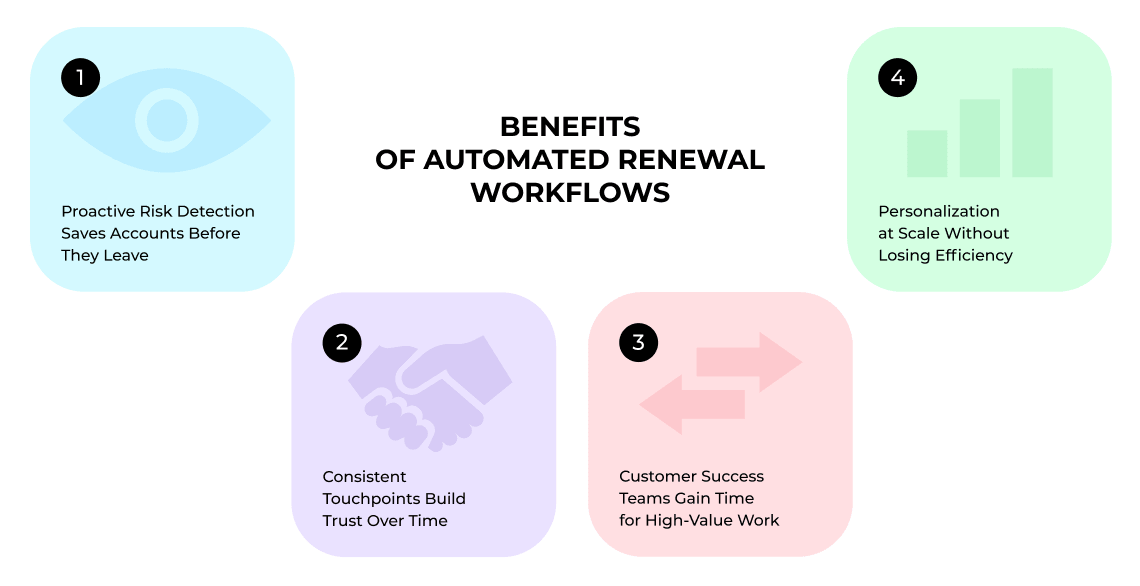
Retention improvements from automated renewal workflows often appear early after implementation. Companies implementing renewal automation report churn reductions exceeding 15%, particularly when proactive systems detect risk signals early.
Waiting for customers to raise issues often leads to missed renewal opportunities. Automated renewal workflows change that dynamic by identifying at-risk accounts based on usage declines, engagement drops, and behavioral signals.
When product usage falls below defined thresholds, automated workflows trigger alerts and engagement sequences. These early signals give teams time to address issues, reinforce product value, and stabilize the renewal conversation before disengagement occurs.
"Churn is like gravity," said Nick Mehta, former CEO of Gainsight. "If something goes up, you've got to fight to keep it from coming down. You have to work to re-earn your customer's business every single day."
Research shows that 71% of businesses report inconsistent brand communication leads to customer confusion. Automated renewal workflows help prevent this by ensuring every customer receives consistent communication throughout the renewal cycle, regardless of contract size or CSM availability.
Pre-built workflows ensure that no account is overlooked during critical renewal periods. When customers know what to expect and experience consistent engagement, trust strengthens over time. This stability supports higher customer lifetime value, reduces churn risk, and increases referrals.
Automation removes hours previously spent on manual tracking, data entry, and repetitive outreach. Customer success managers can move away from spreadsheets and focus on strategic conversations that move accounts forward. Lower-touch accounts continue receiving automated engagement without additional manual effort.
Teams often report gaining significant time to focus on retention and account development. Automated systems handle renewal reminders, quote generation, and follow-up sequences so customer success teams can concentrate on high-value interactions with enterprise accounts or customers who need direct support.
Personalized messaging improves conversion rates and revenue outcomes. According to McKinsey, personalization can lift revenue by 5–15% while also lowering customer acquisition costs.
Automated renewal workflows use usage metrics, engagement signals, and behavioral patterns to tailor renewal communication without increasing manual effort.
Three months before renewal, automated workflows can trigger emails referencing insights such as product usage trends or adoption patterns. This approach allows teams to scale relevant communication across the customer base while maintaining efficiency.
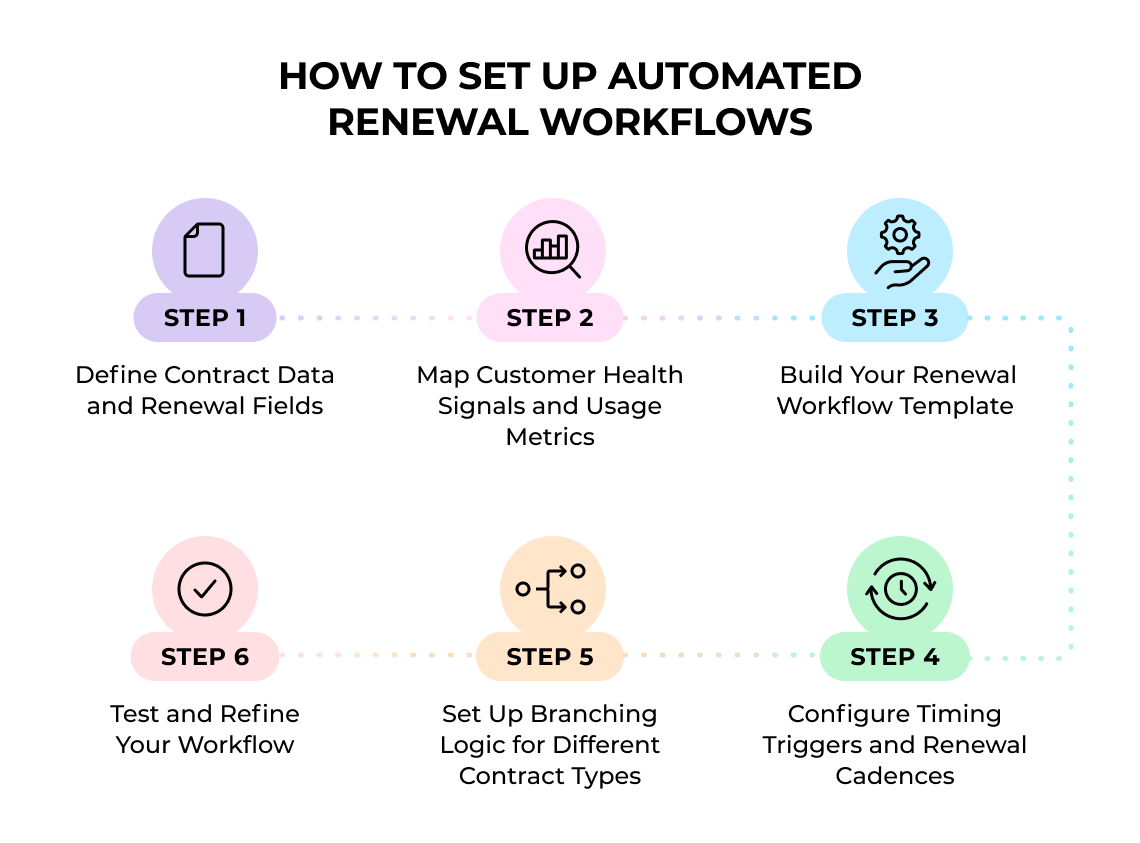
Setting up automated renewal workflows involves six connected steps. The process focuses on organizing contract data, defining triggers, and building repeatable renewal communication inside your CRM.
Clean contract data ensures workflows trigger at the right time. Define mandatory fields for deals entering renewal stages, including contract start and end dates, term length, notice period, auto-renew status, renewal amount, current renewal stage, assigned renewal owner, and risk level.
Clearly define contact roles so renewal communication reaches the right stakeholders, including economic buyers, executive sponsors, and day-to-day operational contacts.
Connect service delivery data to renewal decisions. Track usage indicators such as billable hours consumed, milestone completion, platform adoption, and support volume.
Include engagement signals such as meeting participation, email responses, and satisfaction scores. Financial indicators like payment timeliness and budget utilization also contribute to a reliable customer health view.
These inputs form a customer health scoring model that helps teams classify accounts as “Healthy,” “At Risk,” or “Needs Attention.” Teams often assign weights to different signals (usage, engagement, and financial indicators) to reflect their importance in the renewal process.
Create a renewal workflow template inside your CRM once the required contract properties are defined. Configure enrollment triggers using the contract end date, activating 120, 90, 60, or 30 days before expiration.
Structure the workflow with automated tasks, email sequences, and stage updates aligned with the renewal timeline.
Define communication touchpoints at key renewal intervals. At 90 days, notify internal stakeholders about upcoming renewals. At 60 days, initiate proposal preparation and legal review. At 30 days, escalate negotiations or trigger additional outreach for accounts showing risk signals.
Automated systems can also send reminders earlier in the renewal cycle, such as at 120, 90, and 60 days, giving teams sufficient planning time.
Already have a CRM but the renewal workflows are not firing correctly? Darwin audits your setup and fixes the gaps.
Multi-year contracts often require a different renewal process than annual agreements. Use conditional branches to segment contracts where term length exceeds 24 months and route them through earlier engagement steps.
For example, executive check-ins may start 150 days before renewal, with ROI reviews scheduled around 120 days. Branching logic can evaluate up to 20 unique conditions using AND/OR rules to direct accounts through the appropriate renewal path.
Start by running the workflow with a small group of pilot accounts before rolling it out broadly. This helps identify issues such as skipped steps, stalled deals, or misconfigured triggers.
Track renewal performance indicators such as renewal rates, task completion, and negotiation timelines. Review overdue tasks regularly, audit workflow completeness monthly, and analyze results quarterly to improve the system over time.
Automated renewal workflows perform best when designed for real operational complexity. The following practices help teams build workflows that support retention rather than add unnecessary process overhead.
Value-based segmentation helps teams prioritize engagement where it has the greatest impact. Structure workflows around annual recurring revenue tiers, customer lifetime value, product usage patterns, and industry segments.
Enterprise accounts may require executive-level engagement and custom ROI reporting. Lower-value segments can rely on digital nurturing supported by human touchpoints when needed.
Many customers prefer human interaction when resolving complex issues. Automation should handle routine tasks such as billing notifications and renewal reminders, while human involvement remains essential during escalations, onboarding, and negotiation stages.
Early problem discovery, stakeholder alignment, and renewal discussions are situations where expert-led interaction adds the most value.
Clear ownership at each stage of the renewal process prevents delays and miscommunication. Customer success teams identify early risk signals and prepare value documentation, while account management handles pricing discussions and negotiation strategy.
Technical teams provide usage insights and roadmap context. Defined task assignments and shared dashboards ensure teams collaborate efficiently during renewal cycles.
Track workflow completion rates and operational efficiency to identify bottlenecks. Monitor time-to-completion for key renewal tasks and review overdue actions.
Regular feedback from teams helps refine workflow steps. Review performance weekly for overdue tasks, monthly for process completeness, and quarterly for overall renewal outcomes.
"Everything impacts Net Retention. Every. Thing," said Lincoln Murphy, Growth Consultant and co-author of Customer Success.
Subscription companies often understand the importance of renewal automation. The difficulty usually appears when contract data, customer health signals, CRM workflows, and renewal outreach must operate together.
Many teams still rely on spreadsheets, calendar reminders, and manual follow-ups to manage renewals. As contract volumes grow, these processes become harder to coordinate and renewal risks appear too late.
Darwin works with B2B companies to design renewal systems that connect CRM data, customer health indicators, and renewal workflows into a single operating process.
When companies begin implementing renewal automation, several operational questions typically emerge:
• Contract visibility. Where contract timelines and renewal milestones are tracked inside the CRM.
• Customer health monitoring. Which usage, engagement, and support signals indicate renewal risk.
• Workflow orchestration. How renewal reminders, account reviews, and outreach sequences are triggered.
Darwin helps companies implement these renewal systems inside their existing platforms. This includes configuring CRM workflows, connecting product usage signals, and defining renewal cadences that surface risk signals early in the contract cycle.
With these systems in place, teams gain visibility into upcoming renewals and can engage accounts before churn risk escalates.
Q1. What are automated renewal workflows and how do they work?
Automated renewal workflows manage subscription renewals using CRM triggers, contract timelines, and customer health signals. They send reminders, trigger outreach, and surface at-risk accounts before contracts expire.
Q2. How can automated workflows improve customer retention rates?
Automated workflows detect early churn signals and trigger timely engagement. Teams can reach customers before renewal deadlines instead of reacting after accounts disengage.
Q3. What are the essential steps to set up an automated renewal workflow?
Key steps include defining contract fields in the CRM, mapping customer health signals, building renewal workflow templates, configuring timing triggers, and testing the process with pilot accounts.
Q4. Should automated renewal workflows completely replace human interaction?
Automation handles reminders and routine follow-ups, while human teams manage negotiations, escalations, and strategic accounts. Renewal performance improves when both work together.
Q5. What metrics should be monitored to optimize renewal workflow performance?Teams track renewal rate, workflow completion rates, time-to-completion for renewal tasks, and overdue actions. These metrics help identify bottlenecks in the renewal process.
Contact Darwin today for a custom SEO strategy that combines the best automation tools with proven tactics to dominate Google and AI search results.
Talk to us