Learn how to optimize content for AI search, earn citations in AI-generated answers, and get your brand found in 2026.
Quick Answer:
AI search optimization means structuring content so AI-powered search engines (ChatGPT, Perplexity, Google AI Overviews) can cite your brand in generated answers. The core tactics include placement in authoritative list articles, schema markup, E-E-A-T signals, and alignment with question-based queries. This approach covers GEO (Generative Engine Optimization) and AEO (Answer Engine Optimization) alongside traditional SEO.
• Zero-click. Nearly 60% of Google searches end without a click. AI Overviews appear in roughly 47–50% of U.S. searches.
• Passage-level. AI systems cite content at the passage level, not the page level. Structure matters more than length.
• Foundation. Question-based keywords, clean headings, schema markup, and citation-worthy elements are required.
• Platform differences. ChatGPT, Perplexity, Google AI, and Claude use different citation patterns. One approach leaves gaps.
• Measurement. Tracking AI mentions and citations is now part of measuring search reach.

Not sure if your content is ready for AI search? Darwin's SEO and GEO audit shows exactly where you're visible, and where you're not.
Search has quietly split into two different models. One is the Google you know: rankings, clicks, blue links. The other is AI-generated answers, where answer engines synthesize responses and cite a limited set of sources, often without sending users anywhere.
Most companies still optimize for the first model, while the second already shapes who gets discovered. This guide explains what AI search optimization requires in 2026: technical foundation, content structure, tools, and measurement.
AI search optimization focuses on making content citable in AI-generated answers, not just rankable in search results.
You can rank #1 in Google and still be invisible. Nearly 60% of searches end without a click, and only 14–17% of URLs cited by AI systems come from traditional top 10 results. The rules for getting found have changed.
AI search optimization makes content discoverable, extractable, and citable by AI-powered search engines and answer systems.
While traditional SEO focuses on rankings and clicks, AI search optimization focuses on becoming the source AI systems cite when generating answers.
You’ll also see it called AISEO, Generative Engine Optimization (GEO), or Answer Engine Optimization (AEO). These terms point to the same shift: content needs to be structured so systems can interpret it, trust it, and use it in responses.
AI-generated answers now shape how users search, compare, and evaluate information.
How Search Rankings Relate to AI Visibility
Ranking in search results no longer guarantees presence in AI-generated answers.
Nearly 60% of searches end without a click, as users get answers directly from AI-generated summaries. AI-generated responses increasingly appear within search environments, often surfacing above traditional results and resolving queries before users reach standard listings.
The overlap is limited. Research shows only around 14-17% of URLs cited by AI systems match top organic results. Content can rank first in search and still be absent from AI responses.
"Zero-click results are not the death of SEO — they're the shift toward visibility and reputation. The click is no longer the conversion; the mention is," said Rand Fishkin, Co-founder of SparkToro.
Traditional search metrics capture only part of the picture, as more journeys end inside AI-generated answers.
Ranking on page one is no longer enough. Darwin can show you where your brand stands in AI search.
AI systems select content that answers questions clearly, is easy to extract, and can be used as a reliable source.
They interpret intent, retrieve relevant passages, and generate responses by combining selected sections from multiple pages. This process works at the passage level rather than the page level.
Content is more likely to be cited when it answers questions near the top, uses well-defined headings, separates content into distinct sections, reinforces consistent entities, and includes original insights or data. Credibility signals, both on-site and off-site, also influence selection.
"Answer Engine Optimization is about clarity, context, and corroboration. The more your facts align with trusted sources, the more AI trusts your content to speak for you," said Aleyda Solis, Founder of Orainti.
Search behavior shifts toward full questions and multi-step exploration during AI interactions.
Search behavior has moved from keywords to full questions. Voice queries often reflect local intent, especially in mobile and assistant-driven use cases.
In conversational systems such as ChatGPT, many queries no longer align with traditional search intent and instead reflect new or less common patterns. Strategies need to reflect this conversational flow, where one query expands into multiple related searches handled within a single interaction.
AI visibility depends on whether systems can access and use your pages.
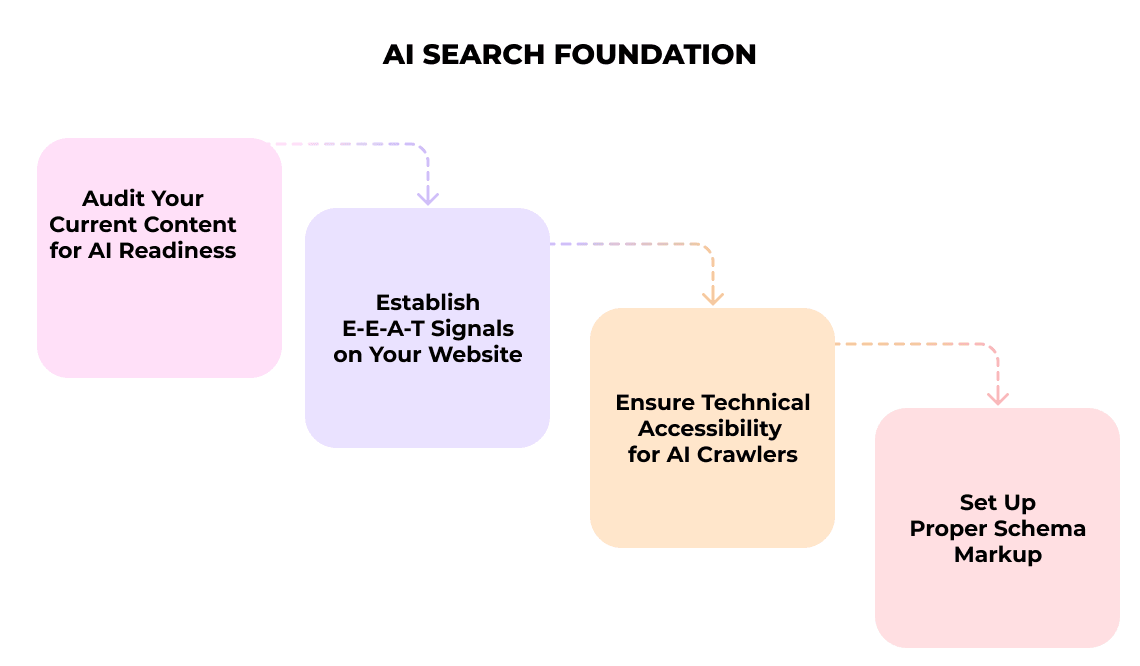
AI systems rely on what they can access. Accessibility is revealed when pages are viewed without JavaScript. Elements that disappear in this state are often missed during indexing. If key content depends on rendering, it may not be processed.
Readability affects selection. Pages with inconsistent formatting, buried insights, or missing schema are less likely to be used. Article, Author, and Organization schema help confirm context and credibility.
Duplicate or overlapping pages weaken relevance. Consolidation and updates help concentrate authority on fewer, stronger pages.
E-E-A-T (experience, expertise, authority, and trust) signals affect whether content is selected.
These signals shape how pages are interpreted and whether they are considered reliable sources.
Show experience through author bios and direct references in your writing. Demonstrate expertise through depth, accuracy, and citations to reputable sources.
Build authority through consistent publishing and mentions from trusted sites. Maintain trust with HTTPS, clear contact details, accurate content, and updated policies. For YMYL (Your Money or Your Life) topics, these signals directly influence selection.
Systems can only use content they can access.
Your robots.txt file should allow key bots to reach important pages. Clear site structure and consistent internal links help systems discover and interpret content correctly.
Technical issues such as broken links, redirect loops, or slow load times reduce how reliably content is retrieved and used.
Content behind logins remains inaccessible. These systems operate as logged-out users, so public pages define how your expertise is interpreted.
Schema markup defines what each page represents and which parts can be used in responses.
It helps systems interpret entities such as company, author, product, or article, and connect them across your site.
Use relevant types such as Article, Organization, Person, FAQ, or LocalBusiness based on page purpose.
Consistent entities and schema markup make content easier to retrieve, combine, and reference in generated answers.
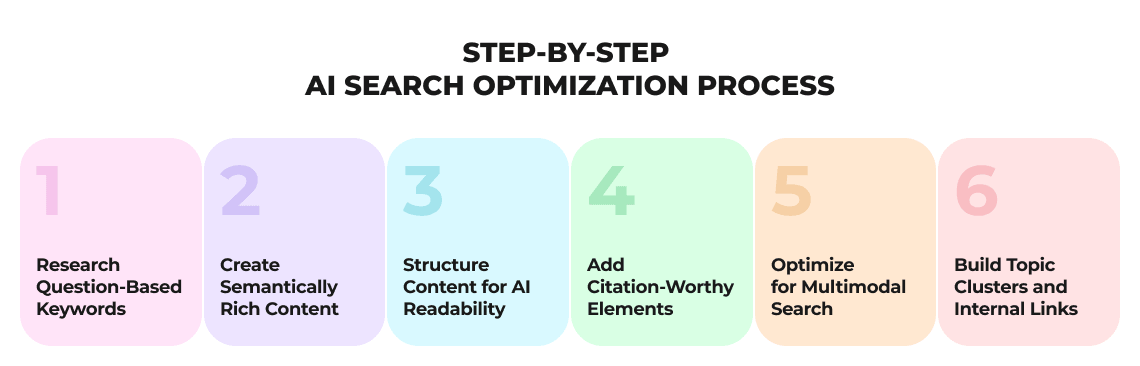
Each step builds on the previous one. Start with how users phrase questions, then shape content for extraction, strengthen citation signals, and expand into multimodal and topical coverage.
AI search starts with questions, not keywords. Queries framed as who, what, where, when, why, and how align with how users interact with answer systems.
Map your core topic into related questions and sub-questions. Focus on how a single query expands into follow-ups and deeper exploration.
Use sources such as search suggestions, “People Also Ask”, or platforms like Reddit and Quora to identify how questions are phrased and repeated. Tools such as Semrush or AnswerThePublic can support this process but should not define it.
Gaps appear where existing content does not provide direct or structured answers. Covering these gaps strengthens relevance and improves selection in generated responses.
Content should explain the topic using related terms and connected entities that provide context.
Each section should answer a specific question directly. Structure content around a primary question and a small set of logical follow-ups that reflect how users explore a topic.
Use sources such as search suggestions or question-based datasets to identify how topics are broken into sub-questions. These inputs can guide structure, but the goal is to build a coherent narrative, not mirror a list.
Well-organized content allows systems to extract, combine, and reuse sections in generated responses.
AI systems work with formatted sections rather than full pages. Structure defines what can be extracted and reused.
A defined hierarchy, consistent headings, and separation between sections help isolate answers within the page.
Formatting choices such as paragraph length, spacing, and visual separation influence how content is parsed and combined into responses.
AI systems prioritize content that is clearly attributed, specific, and verifiable.
Credibility comes from identifiable authorship, referenced data, real examples, and original materials that support claims.
Replace vague marketing language with measurable statements. For example, “increased trial conversion rates by 340% within 90 days” provides stronger evidence than general claims.
Direct links to primary sources within the text help connect statements to their origin and make content easier to verify.
Search now spans text, images, video, and voice. Content needs to work across these formats.
Visual and media elements provide additional context alongside text. Descriptive labeling, metadata, and consistent formatting help connect these elements to the main content.
Diagrams, screenshots, and video content extend how information is explained. When organized properly, they can be indexed, interpreted, and reused in generated responses.
Topic clusters connect related content around a shared subject and establish consistent context across pages.
Internal links define how pages relate to each other. These connections help systems follow topics and interpret relationships between entities.
Linking patterns influence how content is navigated and understood. Relevant anchor text and consistent connections reinforce how topics are grouped and interpreted.
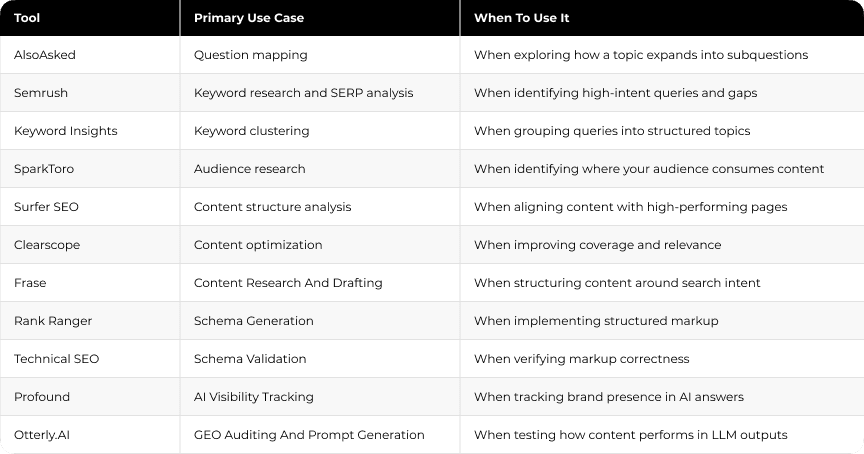
The right tools help identify gaps in coverage and evaluate how content performs in AI-generated results.
Tools support analysis and validation, but outcomes depend on how content is organized and connected.
Semrush’s AI Visibility toolkit measures how often your brand appears in AI results and compares it with competitors.
Not sure which tools fit your setup? Darwin can help you choose and implement the right stack.
Once AI search is live, performance needs to be evaluated differently than in traditional SEO. Signals shift from clicks to presence, selection, and reuse in generated responses.
Citations and mentions reflect how your content appears in AI-generated answers. Citations link directly to your site, while mentions reference your brand without linking.
Tracking how frequently your content is selected across queries provides a baseline for visibility and positioning.
AI search reduces direct clicks but still reflects demand and relevance.
Search impressions and branded queries indicate how visibility changes, even when interactions happen outside the website.
Different systems surface content in different ways. Some rely on a limited set of sources, while others combine a broader range.
Comparing presence across platforms helps identify where content is consistently selected and where gaps remain.
Testing content against real queries shows how it appears in generated responses.
Observing which pages are selected and how they are presented helps refine structure and positioning.
Content performance changes as systems update and new sources appear.
Regular updates help maintain relevance and keep content aligned with how topics are interpreted and surfaced.
AI answer engines cite a small set of sources per response. If your content is not structured for citation, your brand does not appear, even if your content is strong.
The gap between companies that show up in AI search and those that do not usually comes down to three things: whether AI crawlers can access the content, whether the page structure allows passage-level extraction, and whether the right trust signals are in place for AI systems to treat the source as credible.
Darwin works with B2B companies on the full setup. We audit what is blocking your content from being cited: crawlability issues, schema gaps, content structured for human readers but not for AI extraction. Then we fix it. This includes schema implementation, content restructuring for GEO, internal linking strategy, and citation tracking across AI platforms.
Most of the companies we work with already have content and rankings. What they are missing is visibility in AI-generated answers. That is where we focus.
Q1. What is AI search optimization and how does it work?
AI search optimization focuses on structuring content so it can be selected, cited, and reused in AI-generated responses. Instead of optimizing for rankings alone, content is organized into clear sections with direct answers, strong context, and signals that help systems interpret and trust it.
Q2. Why is traditional SEO no longer enough?
A large share of searches now ends without a click, with answers delivered directly in AI-generated summaries. Content can rank highly in search results and still not appear in these responses, as AI systems select sources based on structure, clarity, and citation signals rather than position alone.
Q3. How do AI systems choose which content to cite?
AI systems prioritize content that answers questions directly, uses well-defined headings and divides content into distinct sections. Pages that include original data, practical insights, and consistent entity signals are more likely to be selected and referenced in generated answers.
Q4. What technical setup is required for AI search visibility?
Content must be accessible to crawlers, load quickly, and be organized with clear structure and internal links. Schema markup helps systems interpret page context, while consistent entities and clean formatting improve how content is processed and selected.
Q5. How can I measure AI search performance?
Performance is measured through citations, mentions, and visibility across AI platforms. This includes tracking how frequently your content appears in generated responses, how branded search evolves, and how presence changes after content updates.
Contact Darwin today for a custom SEO strategy that combines the best automation tools with proven tactics to dominate Google and AI search results.
Talk to us